
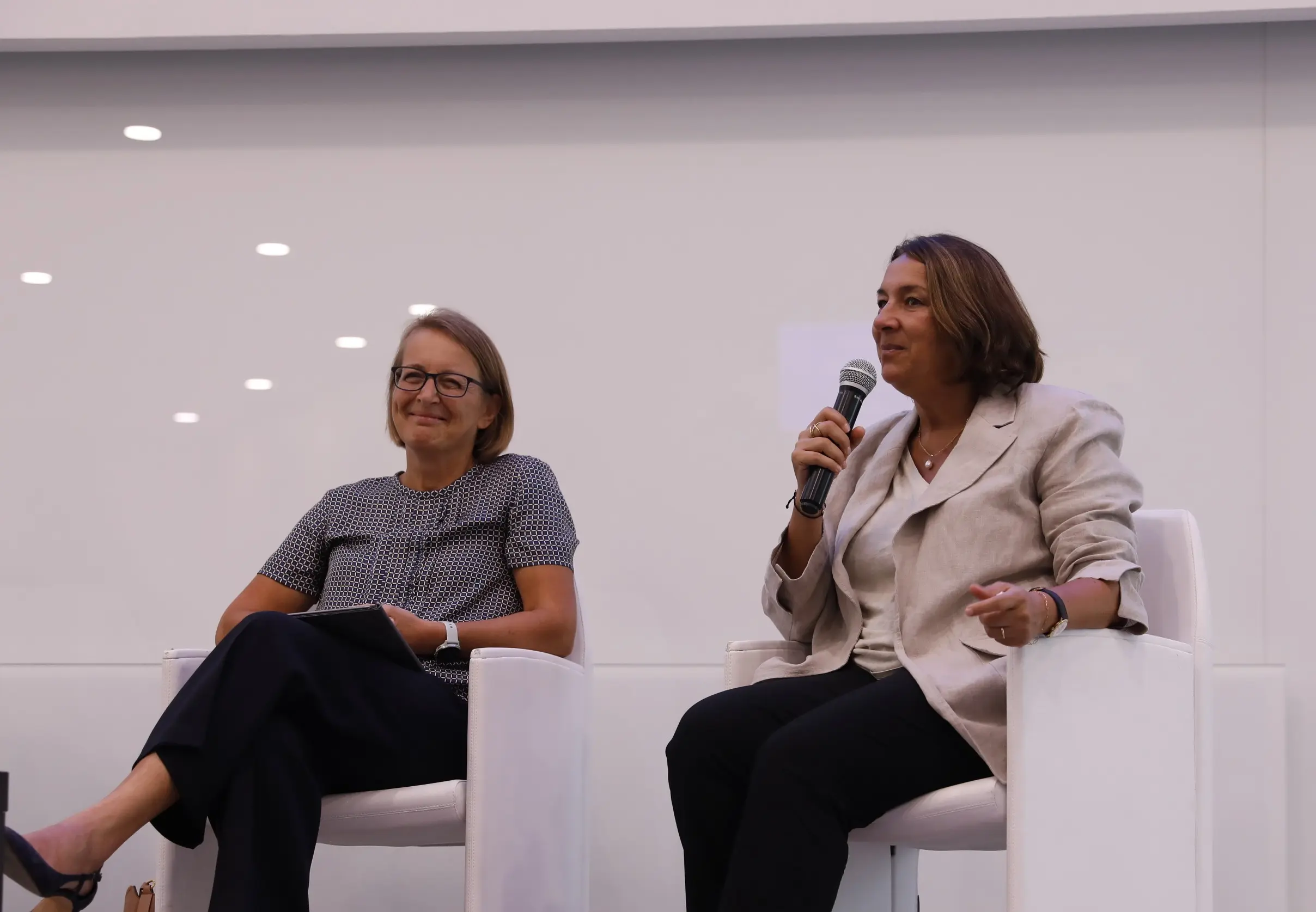
We meet here at the International Engineering Festival at Politecnico di Milano, so I’d like to start by asking you something about your collaboration with our university.
I have the great pleasure and honor of being part of the scientific committee of Human Tech, which is a project of the Department of Excellence focused on human–machine collaboration. So Raffaella [Cagliano, Director of the Department of Management Engineering] and I have now been working together for three years, and I’m very happy and proud of that.
Let’s take advantage of Professor Cagliano’s presence to better understand what Human Tech is.
R.C.: The aim of the project is to rethink the way technologies are developed and then adopted in production processes, value chains and work organization, in order to keep the person at the center. So making sure that technologies are positive for society and for people’s well-being.
It is a major overarching project — started in 2023 and lasting five years — aimed at creating several research streams on this topic.
Darya, speaking precisely about keeping the person at the center, you talked about AI as in some way dangerous for women. Is this only about the issue of bias, or are there dangers that are even more hidden?
One of the dangers is that, by working on historical data, we end up propagating and amplifying biases and stereotypes from the past. Phrases like “Woman at the wheel, constant danger” will contaminate knowledge.
Another danger is the fact that, by not involving women in the creation of these systems, we exclude 50% of knowledge and the female perspective, which is different. In fact, I would use the word knowledge on purpose.
Think for example of women’s medicine, of gender-specific medicine. The involvement of women means we can better understand symptoms; men simply cannot know everything, they have a gendered perspective. So, by not involving women’s knowledge, we risk creating incomplete systems.
The third problem is that women, by not studying these subjects, prevent themselves from entering the job market and from taking top roles in these systems.
A problem we’ve been carrying with us forever…
The most recent data tell us that women graduate with higher grades and leave school with better diploma and degree scores. But then, by often choosing academic paths that are disciplinarily distant, they do not have the opportunity to work in these sectors.
The last thing to note is that jobs typically held by women, such as call centers, customer service, shop assistants and data entry, are all jobs that in the near future we will be able to quickly replace with generative AI. In fact, it is already happening.
Do you think data are intrinsically affected by bias? And will it ever be possible to separate them?
Data represent a mirror of language, so they are already imbued with bias.
One example above all: if we ask the translator of a famous search engine to translate the sentence “The doctor was an expert” into Italian, the system automatically returns “Il dottore (male) era un esperto.” If instead we insert “The nurse was an expert,” it automatically translates as “infermiera” (female). So it is a translation with gender bias that is actually intrinsic.
I already talked about this in my 2018 TedX; back then it was just an alert. Now we have gained more experience and we can ask ourselves whether we can use AI to clean up these translations. That is, by being aware of biases, systems can design filters that actually clean the data; so, paradoxically, AI can be an excellent ally for us.
You often speak of technology as a tool for women’s empowerment. Can we consider digital literacy today as basic literacy for people? In your opinion, should it be taught in schools from a young age?
Yes, digital literacy is definitely a tool of empowerment.
Think of the #metoo movement: why did it become global? Because women, spreading that hashtag, used the Internet to make a social denunciation. If we know what happens every moment in the world, in Afghanistan or Iran, it is because girls and women there can have a voice through technologies. This is why technologies are tools of power.
What is the problem? That if we use these systems consciously, they become a real ally. But right now, 90% of the AIs we use here are made either in Silicon Valley or in China. They do not include all European history, culture, Greek or Persian culture. It’s as if history were reset, and so we must be careful that these large language models take into account all diversities and nuances.
You say that entrepreneurship is important for women’s empowerment. My curiosity is whether it could somehow be based on a male-centered vision of society to associate personal success with economic gain.
I understand what you mean. But it’s one thing to want to become a billionaire for reasons of mere profit. It’s another thing to have one’s own economic autonomy.
At the moment, in Italy, 47% of women do not work, they do not have economic autonomy. This means that even to buy bread they must ask someone for permission. In previous generations, this economic dependence was contextualized within a social system that provided support for women. Now, with separations and divorces, women who are alone and without work unfortunately represent a new form of poverty. And even for those who work, things are not always easy: women employed in technology sectors face a pay gap that reaches up to 25%.
There is a cultural shift we need to put into practice. Soon, European directives will be issued that should ensure that, for equal tasks, women receive the same salary. We are aware that a woman who does not work is also more exposed to violence.
And this is not a matter of capitalism; it is a matter of finding the best balance in working life.
To read the full interview, go to the Frontiere website.