
This PRIN PNRR project develops and tests new Learning Factory models for engineering education, integrating sustainability, digitalization and human-centred approaches to address contemporary industry transformations.
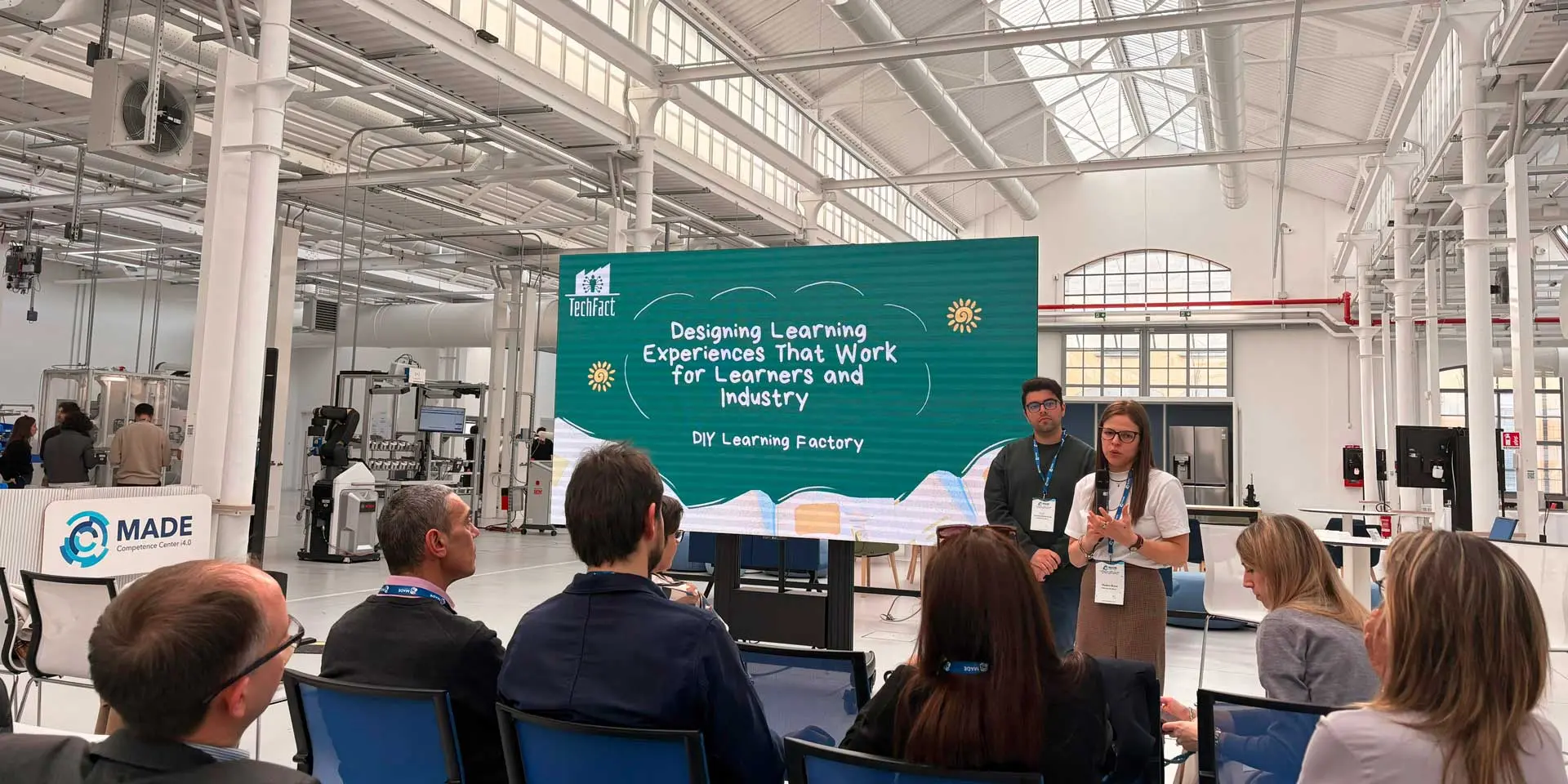
The closing event for TECHFACT - Teaching Factories for Future Engineering Education, a research project funded under the PRIN PNRR 2022 programme dedicated to developing new learning models for training engineers and industry professionals, took place on 27 February 2026 at the MADE Competence Centre.
Developed in collaboration with the Università degli Studi di Bergamo, Politecnico di Milano, and LIUC – Università Cattaneo, the project recognises that the current industrial, environmental, and technological transformations require a rethink of traditional educational models. The transition towards more sustainable, resilient, and digitised manufacturing demands new skills, teaching approaches, and learning environments.
Against this backdrop, TECHFACT sought to design and pilot innovative teaching methods for engineering education based on the Learning Factories model, which are experiential learning environments that integrate theory and practice to solve real-world problems in contemporary industry. Throughout the project, guidelines and frameworks were developed for designing learning spaces that focus on sustainability, digitalization and a human-centered approach, for defining learning activities based on experiential learning, for integrating digital, green and human-centered skills into training programmes, and for experimenting with new educational approaches within Teaching and Learning Factories.
Research activities involved university and high school students, researchers, businesses, and professionals through workshops, laboratories, immersive activities, and experiments conducted at the Teaching and Learning Factories of the project partners.
Particular attention was given to Industry 5.0 (I5.0), Artificial Intelligence, Sustainability and Human-Centered Design. Initiatives included workshops on sustainable manufacturing, experimental activities on well-being and work environments, and labs on collaborative robots and energy consumption.
In particular, the team from Department of Management, Economics and Industrial Engineering of Politecnico di Milano, led by Prof. Monica Rossi, contributed to the development and testing of new learning activities focused on sustainability, systems thinking, and human-centered design. These activities included immersive workshops on the circular economy, I5.0 training experiences, and well-being experiments in production contexts. The aim was to integrate technical, cross-disciplinary, and sustainable skills into engineering education programmes.
The closing event provided an opportunity for universities, businesses, researchers and students to discuss the main results achieved and engage in practical activities to design new educational experiences, as well as testing the tools and methodologies developed during the project.
TECHFACT's most significant achievements include developing methodological frameworks for designing innovative learning spaces and activities, testing case studies in real-world industrial settings, producing scientific publications and making international contributions, and strengthening dialogue between universities and industry on advanced training topics. With the project's conclusion, TECHFACT leaves behind a legacy of knowledge, tools and best practices to support the evolution of technical and engineering education towards increasingly interdisciplinary, sustainable and practice-oriented models.