
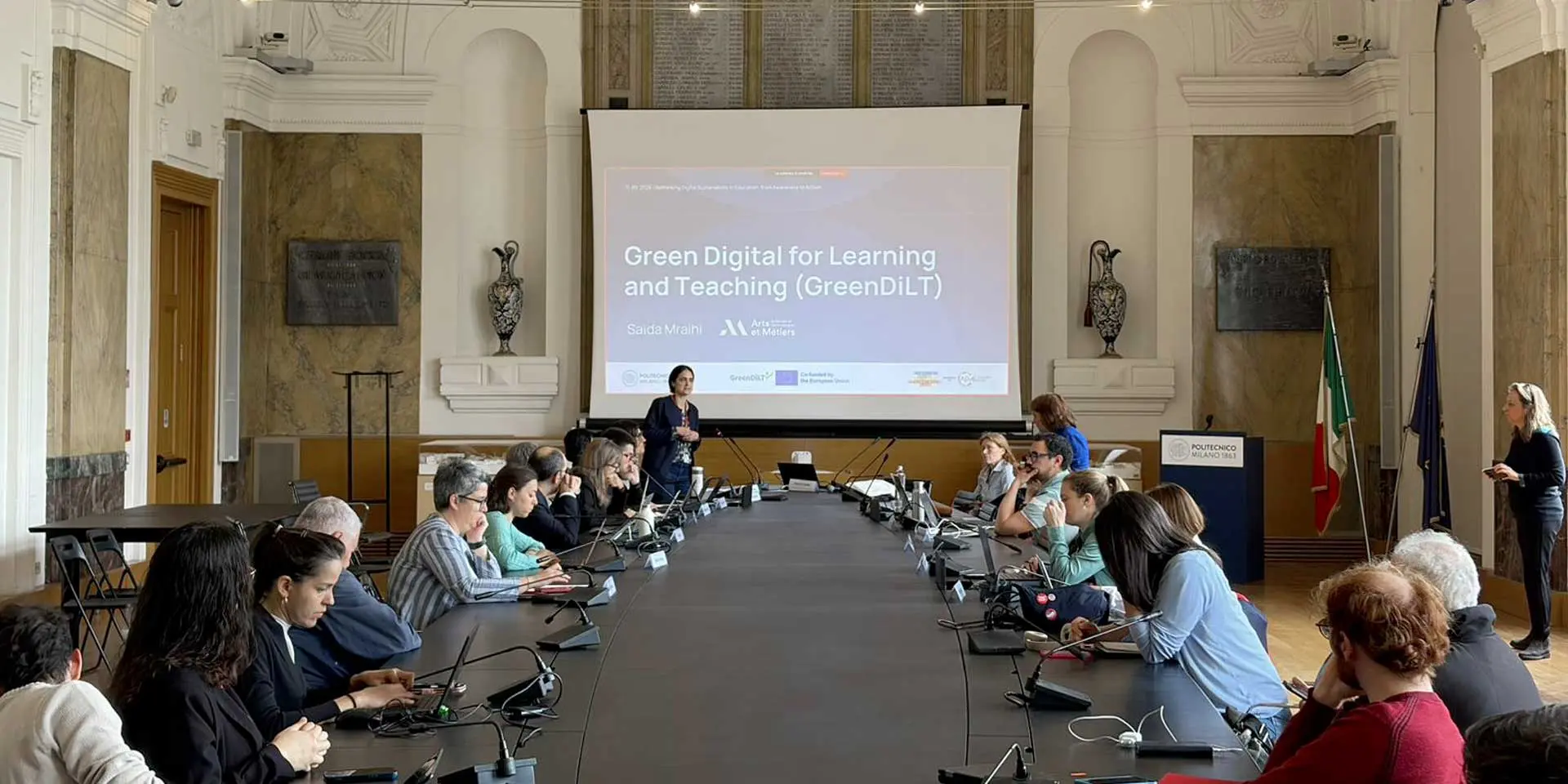
This Erasmus+ project integrates research, tools and training to promote more sustainable digital teaching practices in European universities. It addresses the environmental impact of digital transformation in higher education in a systematic way.
Digital transformation is changing how universities and other educational institutions design and deliver instruction, with online platforms, cloud services, video lectures, collaborative tools and artificial intelligence becoming increasingly important. However, this evolution is not always accompanied by full awareness of its environmental impact.
The GreenDiLT - Green Digital Learning and Teaching, an Erasmus+ project coordinated by Arts et Métiers and developed in collaboration with Politecnico di Milano, TU Delft, AgroParisTech and École des Ponts ParisTech, was born out of this need.
The project involved European universities, students, faculty and technical-administrative staff in a process of research, experimentation and training, with the aim of promoting the more sustainable use of digital technologies in higher education.
In this context, the Politecnico di Milano's Department of Management, Economics and Industrial Engineering team, led by Marta Pinzone and Elisa Amodeo, developed tools to assess and reduce the environmental impact of digital teaching. In particular, they developed a Life Cycle Assessment (LCA) model to analyse the environmental footprint of digital technologies in educational processes. Tested at several European universities, the model made it possible to compare different learning scenarios — from in-person instruction to fully online learning — by considering energy consumption, devices, digital infrastructure, and user behaviour.
In addition to its research activities, GreenDiLT has developed practical tools and training initiatives for the educational community. These are aimed at raising individual awareness and promoting digital sobriety practices within academic institutions. These include a Toolkit to support faculty, students and staff in designing more sustainable educational activities, implementing emission reduction measures and evaluating the environmental performance of digital educational processes. There is also a Digital Carbon Footprint Calculator designed to estimate personal emissions generated by digital teaching and learning activities.
One of the most significant results is the GreenDiLT Academy, which includes two serious game based on Life Cycle Assessment and digital sobriety principles. There is also a free MOOC divided into three modules dedicated to the digital ecosystem, LCA methodology and reducing the environmental impact of digital technologies in universities.
The project’s findings were presented at the “Rethinking Digital Sustainability in Education: From Awareness to Action”, which was organised as part of the Sustainable Development Festival in collaboration with Eleonora Perotto, Head of Environmental Sustainability Unit at the Politecnico di Milano.
During the event, with the support of AMSA, 53 kg of small WEEE and batteries were also collected, turning awareness into concrete action toward more sustainable practices.
With the GreenDiLT Project, the Politecnico di Milano reinforces its commitment to developing more sustainable educational models, contributing to the creation of concrete tools to support the digital transition of European universities with a focus on environmental and social impacts.